
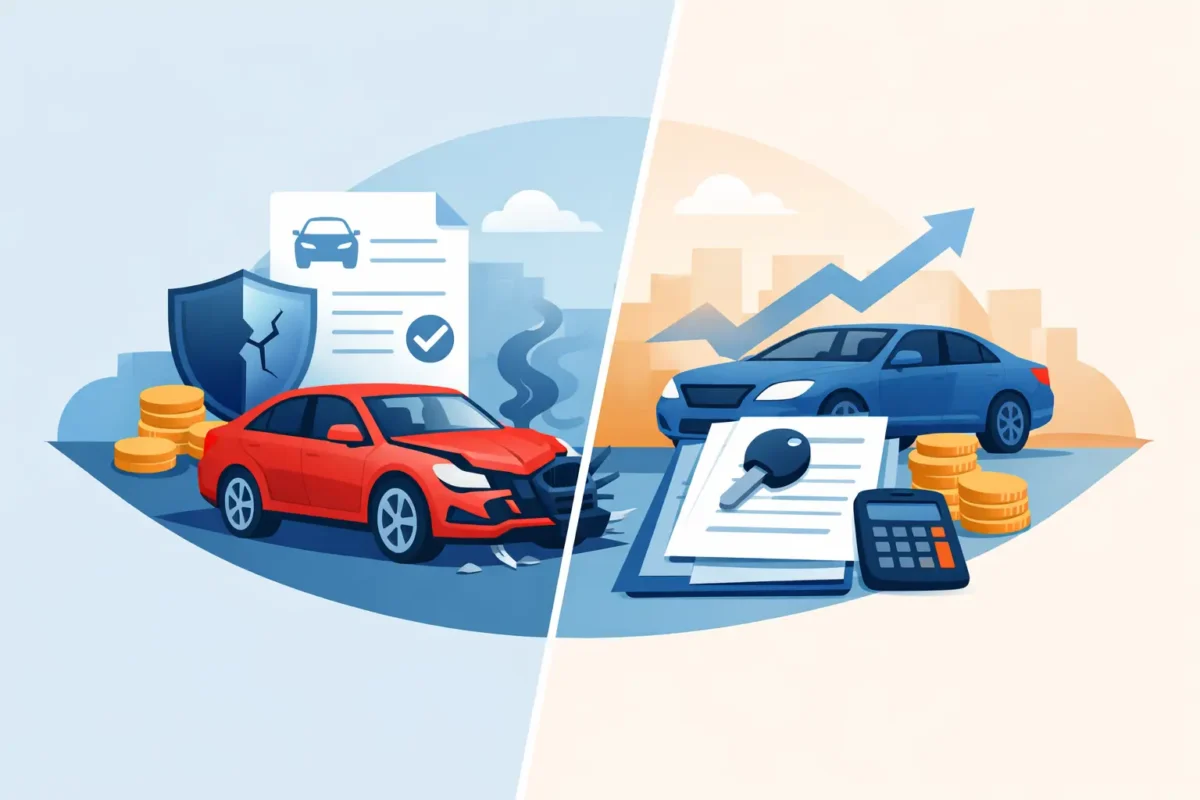
A vehicle can be totaled in seconds, but the loan balance does not disappear with it. That is where gap insurance vs loan payoff becomes a question worth asking before an accident forces a rushed decision. Both types of protection may help when your insurer’s settlement is less than what you owe, but they do not always work the same way – and the wording in your contract matters.
For drivers focused on keeping monthly costs manageable, the right coverage can prevent a totaled car from becoming a long-term debt problem. The wrong assumption about coverage can leave you paying for a vehicle you can no longer drive.
What GAP insurance generally covers
GAP stands for Guaranteed Asset Protection. It is designed for a specific situation: your car is declared a total loss or is stolen and not recovered, and the amount your auto insurer pays is less than your remaining auto loan balance.
Standard auto insurance typically pays your vehicle’s actual cash value, not the amount you originally paid and not necessarily the amount you still owe. Cars can lose value quickly, especially during the first few years of ownership. If you financed a large portion of the purchase price, rolled taxes or fees into the loan, or chose a longer loan term, you may owe more than the car is worth for a period of time.
Here is a simple example. Suppose your insurer values your totaled car at $20,000, but your loan payoff is $23,000. Without protection, you may be responsible for the $3,000 difference. GAP coverage may pay some or all of that covered shortage, subject to the terms of your agreement.
That last part matters. GAP is not a blank check. A contract may limit the amount it pays, exclude late fees, exclude skipped payments, or require you to maintain comprehensive and collision insurance. Your deductible may also remain your responsibility, depending on the policy or agreement.
Gap insurance vs loan payoff coverage
The terms sound interchangeable, and sometimes they are used that way in marketing. In other cases, they describe different products.
GAP insurance is generally intended to cover the gap between an insurance settlement and your outstanding loan balance after a covered total loss. Loan payoff coverage, sometimes called loan or lease payoff coverage, may instead pay a set percentage above the vehicle’s actual cash value. For example, a policy might pay up to 25% above the vehicle’s value, rather than promising to pay every remaining dollar of the loan balance.
That distinction can create very different outcomes. If your car’s actual cash value is $20,000 and your policy pays up to 25% above that amount, the maximum extra benefit could be $5,000. That may fully cover a $3,000 shortage, but it may not cover an $8,000 shortage.
Some lenders, insurers, and dealerships use the phrase “loan payoff” for coverage that functions much like GAP. Others use it for a limited benefit attached to an auto insurance policy. Do not choose based on the name alone. Read the coverage limit, exclusions, deductible treatment, and payoff calculation method before you buy.
The question to ask before signing
Ask this directly: “If my vehicle is totaled today, does this coverage pay my full covered loan deficiency, or only a percentage of the vehicle’s actual cash value?”
Then ask whether the benefit includes your deductible and whether there is a dollar cap. Those answers are more useful than the product label.
When GAP may make more sense
GAP can be particularly valuable when you are likely to be upside down on your loan, meaning you owe more than the vehicle is worth. That can happen for several common reasons: you made a small down payment, financed for 72 months or longer, bought a vehicle that depreciates quickly, or included negative equity from a previous loan in your new financing.
It may also be worth considering if a total-loss bill would put real pressure on your household budget. Even a few thousand dollars in remaining debt can be hard to absorb while you are also trying to replace transportation.
GAP may be less necessary if you made a substantial down payment, have paid down your loan quickly, or your vehicle is worth more than your remaining balance. The value of any protection product changes as your loan balance changes. It is not necessarily something you need forever.
When loan payoff coverage can be enough
Loan payoff coverage may be a practical option when its percentage limit is comfortably higher than the gap you expect to have. It can also be convenient if you prefer to keep the protection within your existing auto insurance policy rather than through a lender or dealership product.
Still, convenience should not replace comparison. Check the premium, claims process, maximum payout, and whether the policy will renew each term. A low monthly cost can be appealing, but it may offer less protection than you expect if your loan balance remains significantly above the vehicle’s value.
If you are deciding between coverage options, compare the likely payout rather than just the price. The least expensive product is not always the best value if it leaves a sizable balance after a total loss.
Do not overlook refinancing
Refinancing can change the conversation around vehicle protection. A lower interest rate or better loan term may help reduce your monthly payment, but it can also affect what happens to protection products tied to your existing loan.
Before refinancing, review whether your current GAP agreement is connected to your original lender, whether it can be canceled, and whether you may qualify for a refund of any unused portion. Rules and refund amounts vary by contract, state, and how long the coverage has been in place.
You should also check your loan-to-value position before replacing your loan. If you still owe substantially more than your vehicle is worth, ask how your new financing and protection options address that risk. If refinancing helps you pay down principal faster or improves your rate, it may reduce the time you spend upside down.
At OpenRoad Lending, the goal of refinancing is to help eligible drivers pursue better terms and more breathing room in their monthly budget. As you compare loan options, take a moment to review the protection connected to your vehicle as well. Lowering a payment and protecting against a major loss can work together, but they solve different problems.
Review these details before choosing coverage
A quick contract review can help you avoid surprises later. Look beyond the product name and confirm the following:
- The maximum amount the coverage can pay after a total loss.
- Whether it covers the full eligible loan deficiency or a percentage of actual cash value.
- Whether your collision or comprehensive deductible is included.
- Exclusions for late payments, prior damage, extended warranties, service contracts, or other amounts added to your loan.
- Whether coverage ends when you refinance, sell the vehicle, pay off the loan, or cancel your insurance policy.
Also confirm whether your lender requires GAP. Some lenders may require it for certain loan structures, while others leave the decision to you. A requirement does not mean every available product offers the same level of protection.
A practical way to decide
Start with two numbers: your current loan payoff amount and your vehicle’s estimated actual cash value. The difference is a rough picture of your potential gap. It is not exact, because a real insurance settlement depends on vehicle condition, local market values, your policy terms, and any deductible.
Next, compare that potential shortfall to the benefit offered by each product. If a loan payoff policy has a cap that would not cover your likely shortage, a broader GAP agreement may be the better fit. If your loan balance is already close to or below the vehicle’s value, you may decide additional coverage is no longer worth the cost.
A total loss is never convenient, but your financial plan does not have to depend on guesswork. Check your loan balance, read the coverage language, and make sure the protection you choose fits where you are now – especially before refinancing or taking on a new loan term.